By Seth Waite · Partner & Chief Strategist · August 21, 2026
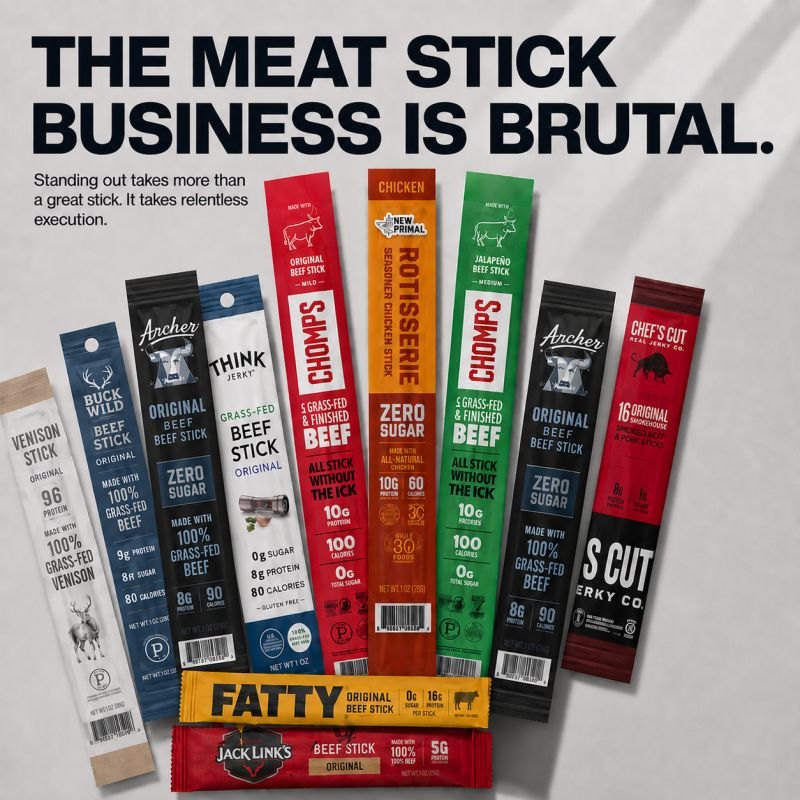
I've had a meat stick every single day for years. It's the most boring habit I have, and it explains a $4.2 billion category — one where the pioneers didn't take share, they manufactured buyers. Then everyone copied the ingredient deck.
Non-jerky dried meat snacks +18.4% · Circana, 52wk to 5/17/26
+2.1%
Jerky growth on $2.5B
+64.9%
Private label dried meat snacks
18.7%
Of 922 live meat snack ads name an occasion
Contents
Ten sections. One argument.
Clean label, grass-fed, zero sugar — all of it is now table stakes. The pioneers spent a decade educating consumers and that education became a public good every new entrant free-rides on.
So we went to the AdVault and read every live ad we hold for the category to see who is actually claiming ground.
We rebranded survival technology as a lunchbox item.
Curing meat is one of the oldest technologies we have. Salt and smoke were how you got through a winter, crossed a plain, or fed an army. Every culture that had to move protein across time and distance invented a version of it.
Pemmican
Cree · North America
Dried meat pounded with rendered fat and sometimes berries. Calorie-dense, shelf-stable, portable. The original bar.
Biltong
Southern Africa
Air-dried in vinegar and spice rather than smoked. No heat, no sugar — which is why it reads so cleanly on a modern label.
Landjäger
Alpine Europe
A semi-dried, pressed sausage carried by hunters and soldiers. Structurally, this is the meat stick.
Ch'arki
Quechua · Andes
The Quechua word we turned into jerky. Freeze-dried in thin air at altitude, long before refrigeration.
For thousands of years this was infrastructure. Now it has a nutrition panel, a Whole30 seal and a QR code, and it sits between the protein bars and the trail mix.
The reframe that made a category
Nothing about the product changed. What changed is that we stopped selling it as what you eat when there's nothing else, and started selling it as what you choose when you could have anything.
That's the whole trick, and it's worth sitting with before we get to the numbers. A meat stick in 1850 was a hedge against scarcity. A meat stick in 2026 is a hedge against your own snacking decisions. Same salt, same smoke, opposite job.
02Market-making
They didn't take share from Jack Link's. They manufactured buyers who didn't exist.
The New Primal and Chomps were both founded in 2012 — Jason Burke launched the first, Pete Maldonado and Rashid Ali the second, on roughly $6,500 of pooled personal money. Chomps went full-time in 2016 after landing Trader Joe's, which is why that year gets miscredited as the founding.
Neither brand ran a share-stealing playbook. They went after people who were never going to buy jerky under any circumstances — and by Chomps' own account, most of the people they landed had never eaten it.
“
Our retail expansion story isn't about taking share — it's about growing the category.
Ali has separately said roughly two-thirds of Chomps consumers had never tried jerky before. Worth flagging: that figure is an executive's characterisation of the company's own data, not published research — we've left it attributed rather than dressed up as a study.
Archer tells the same story from a different seat, and frames it as a change in who's willing to walk down the aisle at all.
“
It really has created a sea change within the category where a lot of these consumers have rediscovered meat snacks and said, ‘Wait a minute, this isn't my father's meat-snacks category.’
That's not competing. That's market-making. And it worked almost too well — because a category you grow for everybody is a category everybody can enter.
Sticks didn't beat jerky. They left it standing still.
Circana's 52 weeks to May 17, 2026 tell the story in two lines. The non-jerky side of dried meat snacks — the segment meat sticks dominate — did $4.2 billion at +18.4%. Jerky did $2.5 billion at +2.1%.
Dried meat snacks: two segments, two different businesses
US multi-outlet dollars · 52 weeks ending May 17, 2026
Meat sticks & othernon-jerky
$4.2B
Jerkyslices & strips
$2.5B
Sticks growthyear over year
+18.4%
Jerky growthyear over year
+2.1%
Circana, 52 weeks ending 5/17/2026, reported in Snack Food & Wholesale Bakery, State of the Industry 2026. Circana labels the segment "all other dried meat snacks" — the residual after jerky, which meat sticks dominate but do not exclusively comprise.
Slim Jim's brand director puts the share shift at 54.4% of meat snack dollars today, up from 37.9% in 2022, with jerky falling from 46.8% to 34%. Take that as a competitor executive's framing rather than a clean Circana readout — his two numbers total 88.4%, so the denominator is broader than the $6.7B dried-meat-snacks total in the same article. On Circana's own figures the split is closer to 63/37. Either way the direction is not in dispute.
The brand table underneath is where it gets interesting, because the growth is not going to the incumbents.
Who is actually growing in meat sticks
Segment dollars and YoY growth · Circana, 52wk to 5/17/26
Segment dollars
YoY growth
ConagraSlim Jim, Duke's, Fatty
$1.1B
+0.5%
Link SnacksJack Link's
$844M
+7.5%
Chompsindependent
$715M
+61.3%
Private labelretailer brands
$380M
+64.9%
Circana, 52 weeks ending 5/17/2026, via Snack Food & Wholesale Bakery. Growth bars are scaled to the highest value in the set (+64.9%), not to each other's dollar bars.
Read that column again. The two largest players are growing at 0.5% and 7.5% in a segment doing 18.4%. The fastest growth belongs to a fourteen-year-old independent and to store brands. That is what a category looks like when the barrier to entry has quietly collapsed.
Conagra's own reporting doesn't agree with the scanner data, and the gap is worth noting rather than smoothing over: the company reported meat snacks +9% in dollars in the quarter ended February 2026 and said snacks had outpaced category growth for five straight quarters. Shipments and retail scan measure different things over different windows. Both can be true. Only one of them is what the shelf looks like.
04Buyer psychology
Protein is the last macro with zero guilt attached.
You don't cheat with protein. You hit it. That single verb difference is most of the category's tailwind, because it turns the purchase from restrictive into additive. Nobody buys a meat stick to avoid something. They buy it to add something to a number they're tracking.
The demand is real and it is under-served. In a Chomps-commissioned study with SPINS, consumers said they were seeking protein in 36% of snacking occasions — but only 19% of snack purchases actually fulfilled that need.
36%
Of snacking occasions where consumers are seeking protein
19%
Of snack purchases that actually deliver it
17pts
The gap every entrant in this category is running at
On the widely-quoted “86% of Americans want more protein” figure: that comes from a RepData survey of 1,000 adults commissioned by PepsiCo Foods U.S. and first published in the Good Warrior launch release. It is brand research produced to justify a product. The independent benchmark — IFIC's 2025 Food & Health Survey, n=3,000 — puts it at 70%. Use whichever you like, but cite the difference.
The more useful IFIC finding is the one nobody quotes: 79% of Americans don't know or aren't sure how much protein they need. A category selling into a goal its buyers can't quantify is a category where the number on the pack does a lot of work and the label does the rest.
The structural advantage nobody designed on purpose
A stick is self-limiting in a way a bag never is. The stick ends and the portion decision gets made for you. That's not a claim you have to make in an ad — it's built into the format.
Jack Link's marketing lead describes the demand environment as permanently favourable, which is the kind of thing you only say when you've watched it hold for a decade.
“
The good news is that protein, whether it's hot or slightly hot, I've never seen it, in the last 10 years, be less than slightly hot.
There's a trust inversion underneath it that matters for creative. In a Link Snacks / Talker Research survey of 2,000 Americans, 58% said they trust meat snacks most for health benefits — ahead of shakes (27%) and bars (15%). But asked which is healthiest, bars won at 31%, shakes 28%, meat snacks 24%.
People trust the meat and credit the bar. That's a positioning problem, not a product problem, and it's exactly the sort of thing that gets solved with occasions rather than with another spec on the front of pack.
Then the occasions stacked. Every one is a separate purchase trigger.
Lunchbox. Gym bag. Glovebox. Desk drawer. 3pm. Airport. Breakfast. Post-workout. Kid's soccer bag. The category quietly colonised all of them — and each one is a distinct moment of demand with its own competitive set.
At 3pm you're not competing with jerky, you're competing with a vending machine. In a lunchbox you're competing with a cheese stick. In a gym bag you're competing with a shaker bottle. Same product, nine different fights.
🎒
Lunchbox
Parent buys, kid eats. Repeat rate is structural — it's on a weekly list.
Loudest: Chomps
🏋
Gym bag
Post-workout protein. Competes with shakes and bars, not with snacks.
Loudest: Oberto
🚗
Glovebox
Shelf-stable, no refrigeration, one hand. C-store and travel centre territory.
Loudest: Righteous Felon
💼
Desk drawer
The 3pm slump. Nearly nobody claims it in advertising. Wide open.
Loudest: almost nobody
🍳
Breakfast
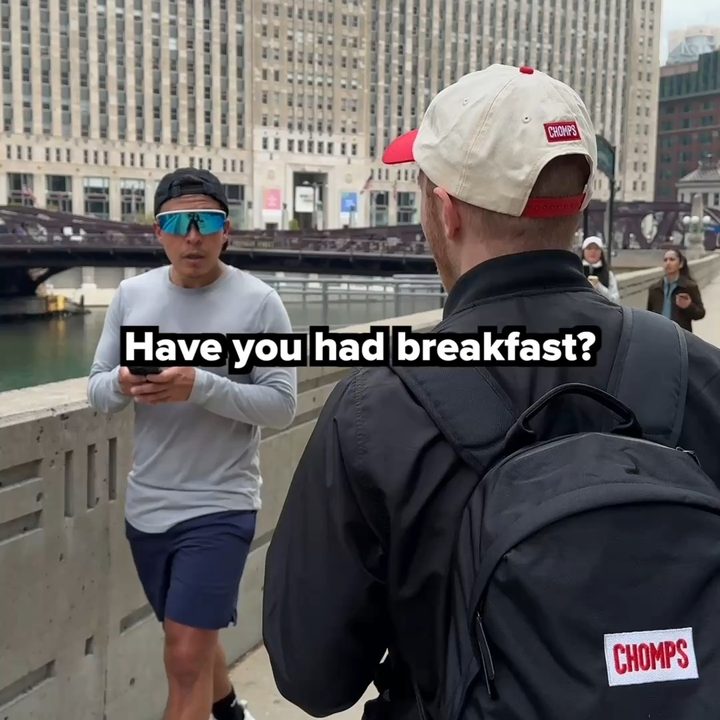
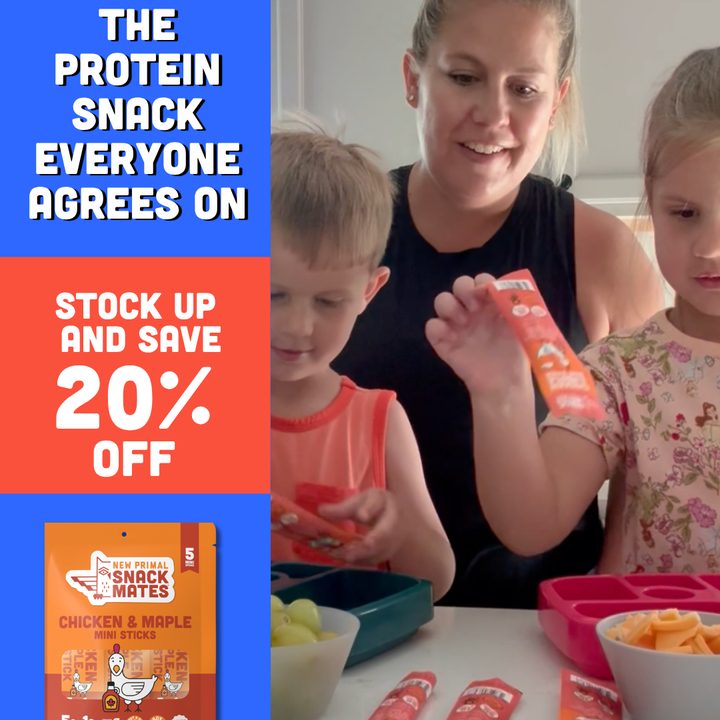
The newest land grab. Chomps built a chicken SKU for it; Jack Link's attacks eggs.
Loudest: Chomps
✈
Airport / travel
TSA-friendly protein. Creator-led content does most of the work here.
Loudest: Chomps
⛰
Trail / outdoor
The category's heritage occasion. Still the most crowded creative territory.
Loudest: Oberto, Tillamook
⚽
Kid's sports bag
"Real protein beats orange slices." Multipack driver, weekend cadence.
Loudest: Chomps, New Primal
"Loudest" = the brand with the highest share of its own live AdVault ads referencing that occasion. It measures advertising voice, not market share or sales.
Chomps' CFO framed the multi-occasion advantage plainly, and it's the single best argument for why this format grew faster than the bag ever did.
“
The other piece putting us in a position to gain new consumers is that we're not a single-use product. We are a meal replacement, meal supplement and snack.
And Archer's read on the ceiling is the number every operator in this category should have taped to a wall:
“
The meat-snack category is really under-penetrated versus other snacking categories. I think there's still a lot of people who don't even know what aisle meat snacks are in.
The education became a public good. Everyone free-rides on it.
Here's the cruel arithmetic of market-making. The pioneers spent a decade and a lot of money teaching Americans that a meat stick can be clean, grass-fed, sugar-free and something you'd hand a seven-year-old. That education doesn't stay proprietary. It sits in the consumer's head, and the next brand on the shelf inherits it for free.
Three things happened in the first half of 2026 that make the point better than any argument.
+64.9%
Private label dried meat snacks hit $380M. Retailer brands grew faster than every national brand except Chomps.
Mar 16
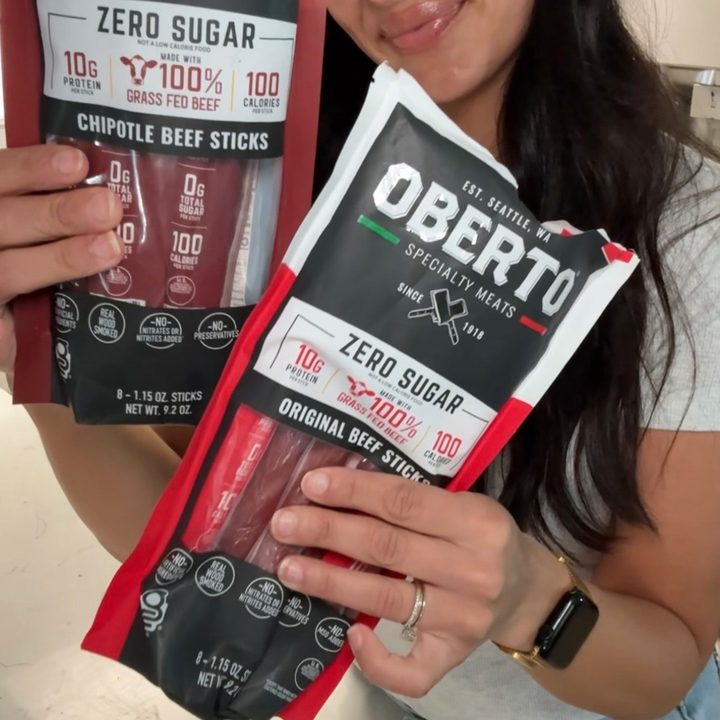
PepsiCo launched Good Warrior — grass-fed beef sticks, 10g protein, 0g sugar, $2.99. Its first owned meat snack brand.
3
Ingredients in Jack Link's counterpunch: beef, salt, vinegar. Announced March 2, shipped Spring 2026.
Look at what PepsiCo's spec sheet says: grass-fed and finished, 10g protein, 0g sugar, 100 calories, no artificial colours or flavours. That is, line for line, the challenger brand claim set from 2016. It took a $90-billion company one product launch to acquire it.
And Jack Link's didn't hedge. It went straight at the clean brands with a shorter ingredient list than most of them, then said so out loud.
“
A lot of brands talk ‘clean,’ but their labels tell a different story. Jack Link's is uniquely positioned to deliver honest, simple, minimal-ingredient products to consumers who demand real transparency.
That second quote is the incumbent's real argument, and it's a good one: the moat isn't the recipe, it's the plant. Link Snacks operates in eleven countries and is building a $450M facility in Perry, Georgia. Over $1 billion of meat-snack processing investment has been announced across the category since 2020.
Meanwhile Conagra's new CEO said the quiet part in July, roughly six weeks into the job:
“
We simply haven't invested enough behind our brands and our supply chain. That has consequences in consumer relevance, in service reliability, and in our ability to compete. We are going to fix that.
Grass-fed, no sugar, clean label — table stakes. None of it is a moat. If a $90B CPG can buy your entire claim set in a single launch, it was never a moat to begin with.
07AdVault analysis
So we read the ads. Almost nobody is claiming an occasion.
If the moat is the occasion, you'd expect the advertising to fight over occasions. We pulled every live ad we hold for the meat snack and jerky brands in the AdVault — 922 ads across 11 brands — and scored each one for whether its copy names a moment (gym, lunchbox, glovebox, breakfast, desk, trail, travel, kid's sport) versus whether it recites a specification (grams of protein, grass-fed, zero sugar, ingredient count, calories, certifications).
The result is lopsided enough that it's the finding.
Spec claims vs occasion claims
Share of 922 live meat snack ads · AdVault, August 2026
Recites a specprotein, grass-fed, sugar, ingredients
55.4%
Names an occasiona specific moment of use
18.7%
Schaefer analysis of the AdVault corpus, run 2026-08-21. Regex classification of ad headline + primary text across 922 live ads for 11 meat snack and jerky brands. Categories are not mutually exclusive; an ad can do both or neither.
Nearly three ads in five make a specification claim. Fewer than one in five names a moment. The category is competing on a nutrition panel it no longer owns, in a fight where the only durable ground is the moment of use.
Split it by brand and the strategy differences are stark.
Share of each brand's live ads that name an occasion
AdVault · brands with 10+ live ads · August 2026
The New Primal12 ads
66.7%
Chomps264 ads
36.0%
Oberto39 ads
35.9%
Tillamook Country Smoker36 ads
33.3%
Jack Link's209 ads
14.8%
Mighty Spark23 ads
8.7%
Righteous Felon159 ads
3.8%
Archer30 ads
3.3%
People's Choice135 ads
2.2%
Bridgford11 ads
0%
Schaefer analysis of the AdVault corpus, run 2026-08-21. The New Primal's 66.7% comes off a 12-ad base — directionally interesting, not statistically robust. Slim Jim, Good Warrior, Singing Pastures, Think Jerky, Mitsoh and 1st Phorm are not yet in the corpus (see the roster below).
Chomps names an occasion in more than a third of its advertising — roughly 2.4x the category rate. Jack Link's, with a comparable ad volume, does it in 14.8%. Righteous Felon, running 159 live ads, does it in six of them.
Broken out by moment, the map of unclaimed ground is easy to read:
Which occasions the category actually advertises
Share of all 922 live ads mentioning each moment · AdVault, Aug 2026
7.1%
Kids / lunchbox
5.0%
Breakfast / morning
3.7%
Travel / trail
2.9%
Gym / workout
1.4%
Desk / 3pm
Schaefer analysis of the AdVault corpus, run 2026-08-21. Bars are share of the full 922-ad set, so they don't sum to the 18.7% headline — a single ad can name more than one occasion.
The desk drawer is the single largest daily-use occasion in the category and 1.4% of live advertising touches it. The 3pm slump is a universal, recurring, high-frequency trigger, and it's effectively unclaimed.
Exhibit A: the spec-sheet default
Four live ads. Every one of them is arguing about the panel — ingredient counts, grams, what's hiding in the competition. Not one names a moment.
Jack Link'sSponsored
•••
Some snacks hit 51 ingredients. We keep it real with 3. Just beef, vinegar, salt.
Video
Basic tierIngredients
Shop now
Jack Link'sSponsored
•••
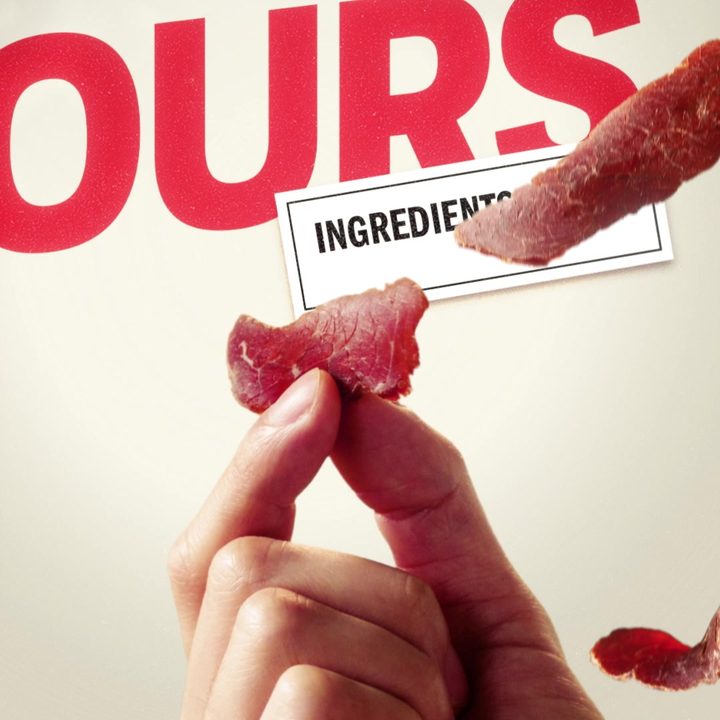
Unlike “healthy” meat snacks, our ingredient list is front and center.
Video
Basic tierIngredients
Learn more
Righteous FelonSponsored
•••
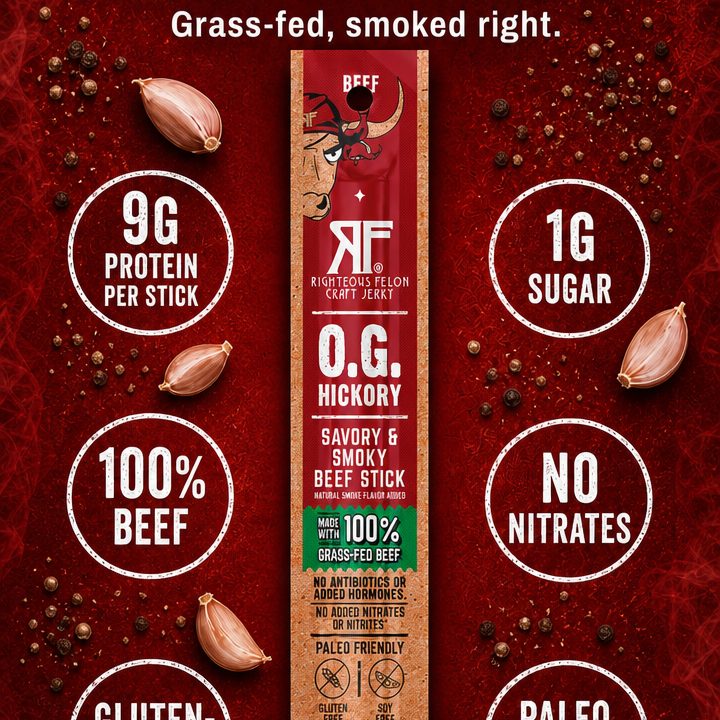
A Snack With A Clean Record Everything to love, nothing to hide. 9g protein · 1g sugar · no junk.
Basic tierIngredients
Shop now
Tillamook Country SmokerSponsored
•••
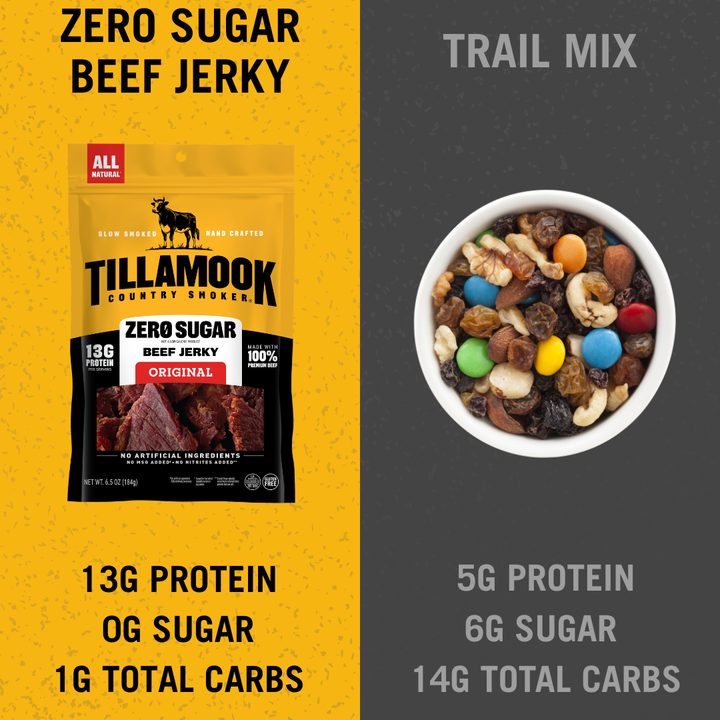
13g protein, 0g sugar, and just 1g total carbs. Compare that to a typical trail mix.
The one incumbent move that is genuinely occasion-led
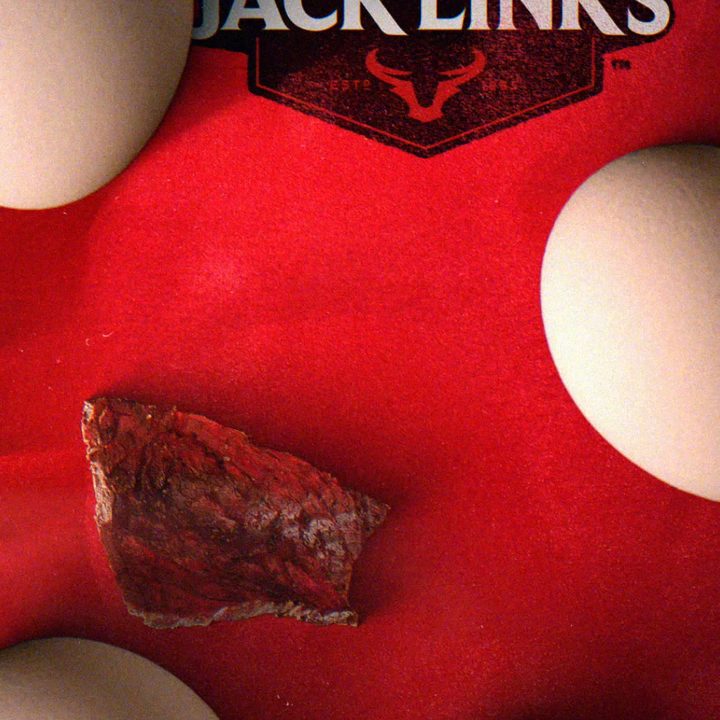
Jack Link's low occasion score isn't the whole picture, because when it does claim a moment it goes after the biggest one available. “Ditch the eggs this morning” and “Does anyone actually like eggs?” are not snack ads. They're breakfast ads — an attempt to substitute for a cooked meal.
Jack Link'sSponsored
•••
Ditch the eggs this morning. Why crack shells when you can get 30g of meaty protein per bag that's ready to go?
Video
Basic tierConvenience
Shop now
ChompsSponsored
•••
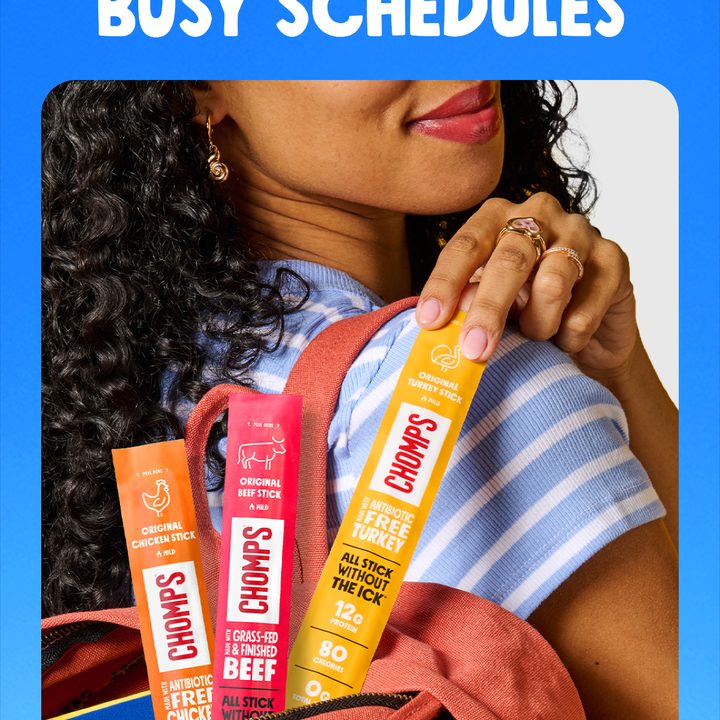
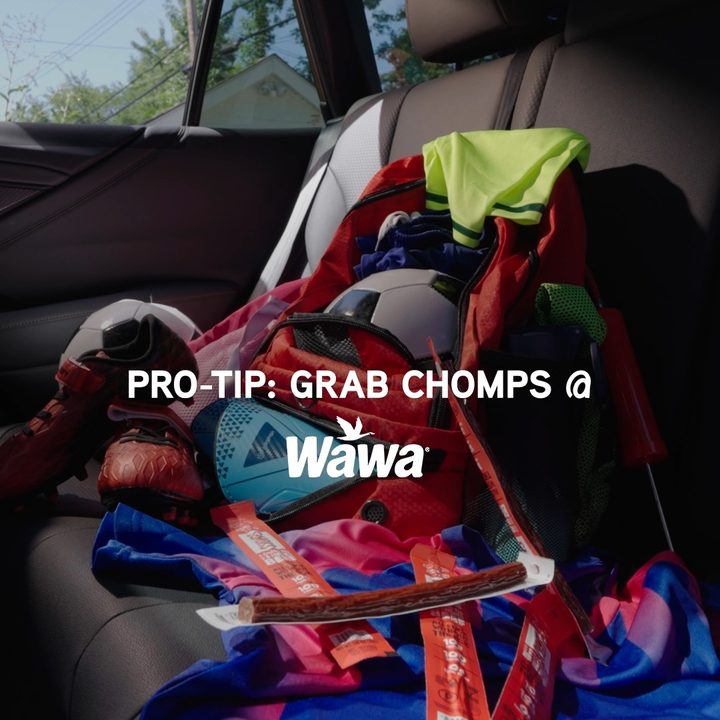
Busy sports schedule this summer? Because when you're playing all day, real protein beats orange slices every time.
Video
EmotionalEntertainment
Enter
ArcherSponsored
•••
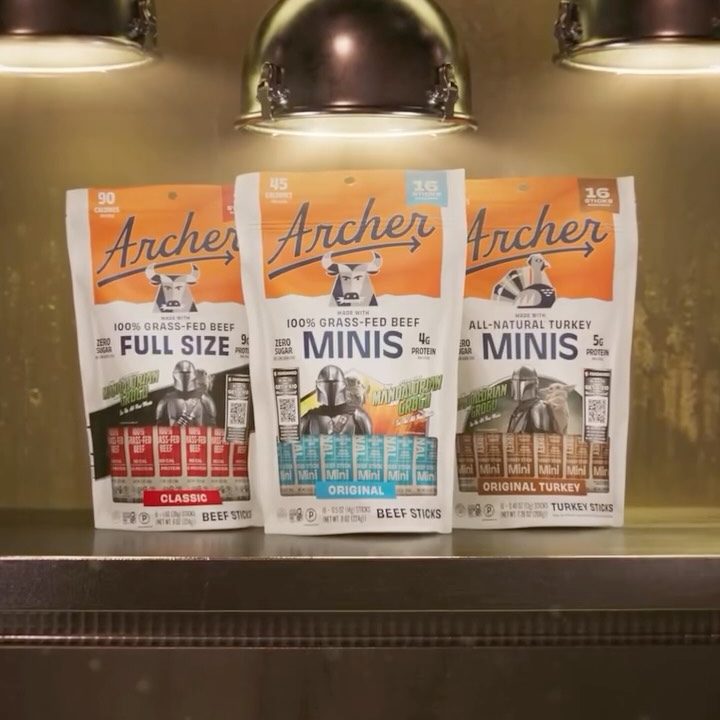
We've entered a new galaxy of flavor. Limited-edition Archer sticks to fuel your journey.
Archer is the interesting outlier. Its SVP of Marketing gives the sharpest occasion commentary in the category — and its live ad mix is 73% entertainment-driven, running a Star Wars licensing partnership rather than occasion creative. The strategy is in the interviews. It hasn't reached the ads yet.
What the corpus actually says
The category talks about itself the way a supplement talks about itself — in specs. The brands growing fastest talk about when you eat it. That is the gap, and it is sitting there in plain sight across 922 live ads.
08The roster
Twelve brands, four strategies, and a lot of silence.
Here's the full set, with what each one is actually doing and whether we can see its advertising. Six of the twelve aren't in the AdVault yet — either because they're new (Good Warrior launched in March), small, not running Meta (1st Phorm sells through its own channels), or not US (Mitsoh is a Yukon-based Indigenous-founded brand selling pemmican and bison sticks).
Best occasion articulation in the category from its CEO: survival fuel reframed as a wellness snack, aimed explicitly at women.
1st PhormProtein Sticks
Fitness audience, owned channel
Not tracked
—
Grass-fed, 18g protein. Sells into an existing supplement audience rather than the snack aisle — a different occasion (post-workout) reached without paid social.
Think JerkyChef collaborations
Craft / chef-led
Not tracked
—
The 2016-era chef-collaboration wave. Little visible activity since. A useful reminder that craft positioning alone didn't scale.
Venison StickAlternative protein
Species differentiation
Not tracked
—
96g protein per pack, 100% grass-fed venison. Competes on species rather than occasion — the purest form of the spec-sheet play.
Indigenous-founded, selling pemmican and bison sticks. The only brand here whose story is the six-thousand-year history — not a US category data point.
Occasion claim rate = share of that brand's live AdVault ads whose copy names a moment of use. Financials are as reported by each source in section 10. "Not tracked" means the brand is not yet in the AdVault corpus, not that it isn't advertising.
Four distinct strategies are visible. Occasion expansion (Chomps, New Primal). Panel warfare (Jack Link's, Oberto, Tillamook, Venison Stick). Identity and craft (Righteous Felon, Slim Jim, Mitsoh). Borrowed attention (Archer's licensing, Jack Link's celebrity work).
Only the first one builds something a competitor can't buy off the shelf.
09The moat
The moat was never the ingredient deck. It's owning the occasion.
An ingredient claim is a fact about a product. Anyone with a co-packer and a budget can acquire it, and in 2026 two of the largest food companies on earth did exactly that inside of a fortnight.
An occasion is a habit inside somebody's day. It has a time, a place, a competitive set and a repeat cycle. You can't buy it with a reformulation, because it isn't stored on the pack — it's stored in the buyer.
The distinction that decides who wins
Specs get you considered. Occasions get you bought again. One is a cost of entry; the other compounds.
Chomps' own account of what matters puts the metric where you'd expect if this thesis is right — not on distribution doors, not on velocity, but on whether people come back.
“
Velocity is table stakes. But the most important metric for us is repeat rate. Chomps' repeat rate is over 40%.
Repeat rate is the occasion, measured. If a stick has a fixed slot in someone's Tuesday, the repeat takes care of itself. If it's a discovery purchase driven by a claim on the front of pack, you're re-buying that customer every single time — and the 119 promotional ads in Chomps' own live set say even the leader is doing plenty of that.
Maldonado made the same point five years ago about what actually separates a real business from a well-funded one, and it has aged extremely well now that private label is growing at 65%.
“
A lot of brands are celebrating that they landed in 10,000 doors or that they raised $10–12m this year. That's the easy part, and the work has only just begun. The hard part is getting the turns and velocities and staying there.
Whoever owns the most occasions wins. Not whoever has the shortest ingredient list — that race ended in March, and it ended in a tie.
If you're operating in this category
Five things the data says to do next.
01
Pick one unclaimed occasion and own it loudly
The desk drawer at 3pm appears in 1.4% of live category advertising. It is a daily, recurring, universal trigger with no incumbent voice. Claiming it costs creative, not R&D.
02
Demote the spec to support
55% of the category leads with the panel. You cannot differentiate inside the majority behaviour. Keep the grams — they earn consideration — but stop making them the headline.
03
Measure repeat rate, not doors
Distribution is now cheap and private label proves it. The only number that separates a habit from a trial is whether they buy it again without a promotion attached.
04
Build the SKU for the occasion, not the aisle
Chomps built a savory breakfast chicken stick because breakfast was the occasion it wanted. Format, flavour and pack size are occasion decisions before they're merchandising ones.
05
Read the trust inversion as a creative brief
58% of people trust meat snacks most for health benefits, but only 24% think they're the healthiest option. That gap doesn't close with another claim — it closes by showing the product inside a moment where the buyer already believes it belongs.
10Method & sources
Where every number came from.
The AdVault analysis
On 2026-08-21 we queried the AdVault for every live ad held against eleven meat snack and jerky brands: Chomps (264), Jack Link's (209), Righteous Felon (159), People's Choice (135), Oberto (39), Tillamook Country Smoker (36), Archer (30), Mighty Spark (23), The New Primal (12), Bridgford (11) and Old Trapper (4). Total: 922 ads.
Each ad's headline, primary text and CTA were concatenated and matched against two keyword sets. Occasion covers gym, workout, pilates, macros, lunchbox, school, kids, soccer, baseball, glovebox, road trip, travel, airport, driving, commute, hike, camp, trail, chairlift, breakfast, morning, eggs, desk, office, afternoon and 3pm. Spec covers protein and gram counts, grass-fed, zero/no sugar, ingredient references, calories, carbs, non-GMO, antibiotic, nitrate, keto, paleo and Whole30.
The two sets are not mutually exclusive — an ad can do both, or neither. Tier and driver labels shown on the ad cards are the AdVault's own creative classification, not ours for this piece.
Site-wide AdVault figures published elsewhere on schaefer.co (156,398 ads / 1,372 brands / 12,779 landing pages) reflect the last full stat refresh; the 922-ad figure here is a live count for this category only.
Four things worth knowing before you quote this page
1. The $4.2B is a segment, not literally "meat sticks." Circana labels it "all other dried meat snacks" — the residual after jerky. Meat sticks dominate it but do not exclusively comprise it.
2. The 38%→54% share shift is a competitor executive's framing. Slim Jim's brand director's two figures total 88.4%, so his denominator is broader than the $6.7B dried-meat-snacks total in the same article. Circana's own numbers imply roughly 63/37.
3. "86% want more protein" is PepsiCo's own research. A RepData survey of 1,000 adults commissioned by PepsiCo Foods U.S. and published in the Good Warrior launch release. IFIC's independent 2025 survey (n=3,000) says 70%.
4. Chomps was founded in 2012, not 2016. Per the company's own account. 2016 is the year Maldonado went full-time after landing Trader Joe's — a real inflection, not the founding. Both Chomps and The New Primal are 2012 businesses, which makes the clean-label meat snack cohort fourteen years old.
We only work with food and beverage brands, and we start every engagement by finding the moment your buyer is already in — then building the creative that shows up there.