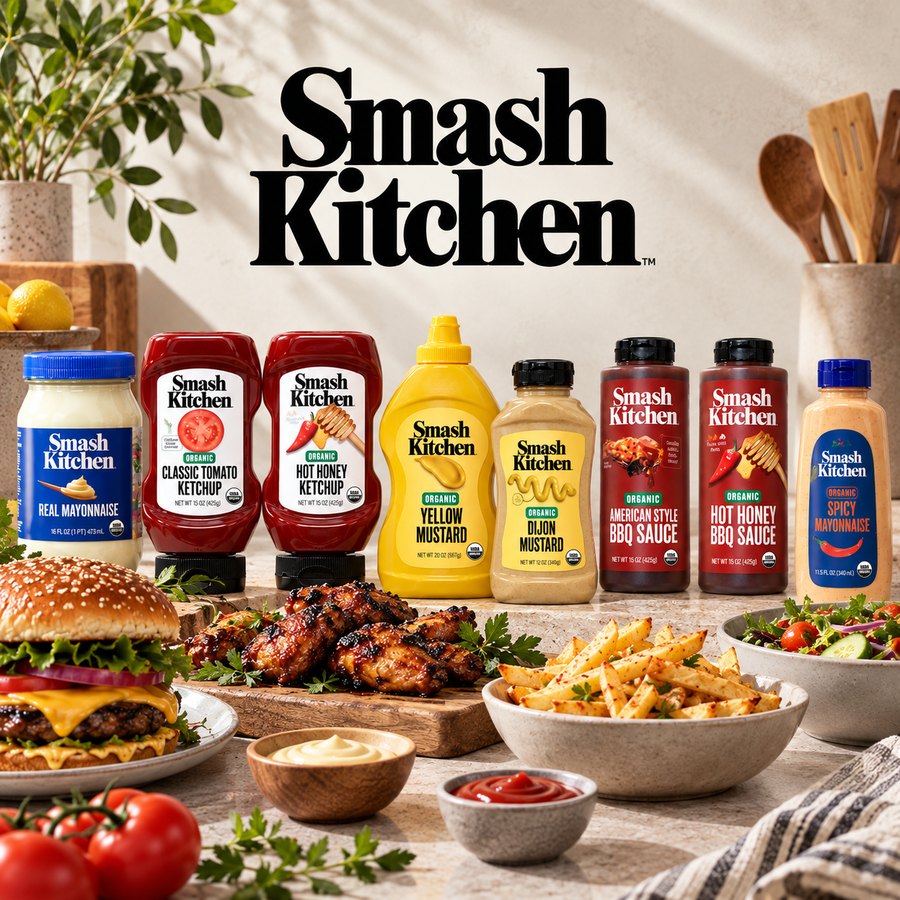
Smash Kitchen came for ketchup. The rest of the fridge was always the point.
A brand with no heritage, no equity and no shelf history did $10 million in six
months by picking one bottle and being right about it, and says it will pass $100 million this year.
The bottle was never the strategy. Here is what the sales data and 2,129 live competitor ad concepts
say about why it worked, and where the same opening sits in your category.
By Seth Waite · 16 September 2026 · 12 min read
$3M+First three months, 1M+ bottles
$100MStated 2026 retail pace
8 → ~60SKUs in seventeen months
11 of 12Condiments' rank on identity-tier ad share
The short version
Smash Kitchen launched into Walmart nationwide in April 2025 with eight SKUs —
ketchup, mustard, mayo and barbecue sauce, with hot honey and spicy variants. Organic, non-GMO, no
high-fructose corn syrup, no artificial dyes. Every item under $5. Seventeen months later it sells
close to sixty items and says it is on pace to pass $100 million in retail sales this year.
It walked into a $12 billion US condiment category that Mintel projects will add another $1 billion
by 2029, against three incumbents who have not meaningfully moved in decades: Kraft Heinz in ketchup,
McCormick's French's in mustard, Unilever's Hellmann's in mayo.
The interesting part is not that a challenger grew. It is what it grew into. Ketchup is one
bottle. Sixty SKUs is a shelf. Something carried the buyer from the first to the second, and it was
not taste. Six charts below, including a read of the category's live advertising from Schaefer's
Ad Vault, which says the incumbents have left the argument that matters almost entirely unoccupied.
The run
Seventeen months, standing start.
Three revenue milestones, all company-reported, and the assortment that grew underneath them. The
dashed segment is the company's own stated 2026 pace rather than a reported result, so read it as
an ambition with a number attached.
From one aisle set to a portfolio
US retail revenue milestones since the April 2025 Walmart launch, with SKU count
on the strip below.
Swipe to see the whole chart →
Revenue figures as reported by the company to Inc. across 2025 and 2026. The $100M point is a stated pace for full-year 2026, not a booked result. SKU count per company statements, September 2026.
The shape is the argument. A brand that is only good at ketchup does not get from eight items to
nearly sixty in seventeen months, because a retailer will not give it the space and a shopper will not go
looking. Something travelled.
The beachhead
Why ketchup was the right door.
Ketchup is not the most profitable condiment. It is the most benchmarked one. Everyone in
the household already knows exactly what it should taste like and exactly what it should cost. That
makes a swap a real verdict rather than a novelty purchase, and it makes the verdict fast.
Pricing the entire line under $5 at Walmart, at parity with legacy competitors, removed the tax that
usually caps better-for-you brands at niche. Debuting in Walmart rather than Whole Foods was a stated
day-one decision, not an outcome.
The mechanism
The reason a shopper swaps ketchup has almost nothing to do with ketchup. They swapped because they
made a decision about what goes in their house. That decision is a household rule,
and a rule travels to every other bottle in the door.
That is how a brand gets from eight SKUs to nearly sixty in seventeen months. It is not line
extension. It is a rule being applied.
Which raises the obvious question: if the rule is that powerful, why is nobody defending against it?
For that we went to the advertising.
The ad data · Schaefer Ad Vault
Where the category spends its attention.
We pulled the condiments, sauces and dressings corpus from Schaefer's Ad Vault:
2,129 distinct live Meta ad concepts across 109 brands, each classified against the
Why People Buy Pyramid™. A concept is a
brand plus a distinct piece of copy, so a brand running one message across forty placements counts
once.
Half the category argues about the product. Almost none of it argues about you.
Share of live condiment concepts by primary motivational tier.
Swipe to see the whole chart →
Schaefer Ad Vault, Meta corpus, pulled September 2026. Concepts deduplicated by brand and copy hash and assigned a single primary tier. Promotional Offer is tracked as a non-motivational tier.
Basic Needs at 51.5% is not surprising in a category sold on taste and price. What should be
surprising is the 7.8%. Personal Growth is where a household rule lives — I am the kind of
person who reads labels, and I decide what my family eats — and it is where a Basic Needs
claim cashes out into permission for the next fifty items. Fewer than one concept in twelve goes
there.
The positions
Every brand in the aisle, on two axes.
Plot each brand by how much of its live advertising sits at Basic Needs against how much sits at
Emotional Value, and the category sorts itself into two camps with almost nothing between them and
almost nothing above them.
Fourteen condiment brands, and the line nobody steps off
Bubble size is the number of live concepts. The dashed diagonal is where the two
bottom tiers account for 100% of a brand's advertising.
Swipe to see the whole chart →
Brands with 16 or more live concepts. Distance below the dashed line is the share a brand spends at Personal Growth, Beyond Self or Promotional Offer combined. Schaefer Ad Vault, September 2026.
Named incumbents Ingredient-led challengers Inside the identity zone Everyone else Bottom two tiers = 100%
French's sits at 81% Emotional Value. Thirteen of its sixteen live concepts are
brand world, nostalgia or partnership. Not one is at Personal Growth or Beyond Self. Heinz splits
59/41 toward Emotional, and what is live right now includes a Disney partnership and a Labor Day
beach post. Graza, Simply Organic and McCormick anchor the opposite corner at 75–85% Basic
Needs.
Both camps are on the same line. The incumbents are not losing an argument at the top of the pyramid;
almost nobody in this aisle is having it. The shaded zone marks the brands where neither bottom tier
takes half the budget, and exactly one of the fourteen is in it:
Cholula, at 18% Personal Growth and Beyond Self — roughly twice the category
average, and the closest thing the aisle has to an identity argument.
Tier mix for six named condiment brands against the category average
Brand
Live concepts
Basic Needs
Emotional Value
Growth / Beyond
French's
16
19%
81%
0%
Heinz
22
41%
59%
0%
Hidden Valley Ranch
42
69%
29%
2%
Duke's Mayonnaise
34
62%
35%
3%
Best Foods (Hellmann's)
33
30%
70%
0%
Graza
102
75%
13%
3%
Category average
2,129
51.5%
34.4%
8.8%
Rows do not sum to 100% because Promotional Offer is excluded. Schaefer Ad Vault, Meta
corpus, September 2026.
The comparison
This is not how every aisle behaves.
You could assume 8.8% at the identity tiers is just what packaged food looks like. It is not. Run the
same classification across twelve grocery categories and condiments lands eleventh of twelve.
Identity-tier share across twelve grocery categories
Percentage of each category's live concepts at Personal Growth or Beyond Self.
Swipe to see the whole chart →
Same method applied to each category's full Meta corpus. Supplements at 61.5% is the natural ceiling — the entire product class is sold as self-improvement. Schaefer Ad Vault, September 2026.
Supplements sell nothing but identity, so 61.5% is the ceiling rather than a benchmark. The instructive
gap is closer in: dairy and snacks, categories with the same shelf economics and the same shopper, run
roughly 70% more identity-tier creative than condiments do. Yoghurt learned to sell
protein as a self-definition. Condiments still sell flavour and a memory.
The format
The category's default ad is a recipe.
Tier tells you what a brand is arguing. Creative type tells you what it is making. In condiments the
answer is overwhelmingly the same thing.
Nearly two in five live concepts are a recipe or use case
Primary creative type across 2,129 live condiment concepts.
Swipe to see the whole chart →
Creative type assigned per concept. “Other” covers concepts that did not resolve to a single dominant format. Schaefer Ad Vault, September 2026.
Recipe creative is cheap, endlessly repeatable and genuinely useful, which is why it is 38% of the
aisle. It is also structurally incapable of carrying an ingredient argument, because the job of a recipe
ad is to show the bottle being used, not to explain what is in it.
Explainer and education creative — the format where a standard gets stated and defended —
is 4.3%. That is the production constraint behind the tier gap. A brand cannot argue
its way up the pyramid in a format that has no room for the argument.
The tell
The ingredient argument, and the fence around it.
Smash Kitchen's entire proposition is a short list of ingredient claims. We counted how many live
concepts in the whole 2,129-concept category make each of them. Almost none do — with one
instructive exception.
How rarely the category makes the claims Smash Kitchen was built on
Count of live concepts mentioning each claim, out of 2,129.
Swipe to see the whole chart →
Keyword match on live ad headline and primary text, counted once per concept. “Organic” is inflated by brand names that contain the word. Schaefer Ad Vault, September 2026.
The exception, and what it tells you
Across ten legacy condiment brands — Heinz, French's, Hidden Valley, Hellmann's,
Duke's, McCormick, Kikkoman, Jif, Miracle Whip and Marzetti — 320 live concepts
produce fifteen ingredient-trust claims between them. Eight of those fifteen are Heinz.
So the obvious conclusion — that the incumbents have not noticed
— is wrong. Heinz has noticed. Eight of its twenty-two live concepts run the line
“made with 7 all-natural ingredients”. But seven of those eight name
Heinz Simply, a separate product line. The claim is fenced inside a sub-brand
rather than stated as a rule about Heinz.
That fence is the whole difference. A claim attached to one line sells that line. A claim attached to
the company becomes a reason to trust everything the company makes next, which is why Smash Kitchen
could put sixty items on a shelf and Heinz Simply is still ketchup.
Seed oils, meanwhile, appear in 14 live ads across the entire category, resolving to
five concepts and three brands: Chosen Foods, Graza and Terrapin Ridge Farms. All three are
challengers. No market leader is in that conversation at all.
And the structural constraint is real rather than stupid: a legacy brand can green-light a
partnership in a quarter, but reformulating a hundred-year-old recipe takes years, and you cannot
credibly run the ad before the reformulation lands. Heinz Simply is what the cautious version of that
bet looks like.
Worth stating plainly: Smash Kitchen is not yet in the Ad Vault corpus, so we cannot
show their tier mix against the category. Their visible engine is retail distribution plus Glen
Powell's owned reach rather than heavy Meta prospecting. We are adding them to the vault next.
The framework
Enter at the bottom. Get paid at the top.
Smash Kitchen enters at Basic Needs and refuses the trade-off, taking ingredient,
taste and price together rather than charging a premium for the virtue. But the payload lands two tiers
up, and that is the part competitors keep misreading as a price story.
Why the two tiers behave differently
Basic Needs claims transfer across a portfolio. Emotional equity does not.
Heinz has to earn every new SKU on its own merits, because nostalgia for
ketchup is not nostalgia for taco sauce. A brand that wins on an ingredient standard inherits
permission for the next fifty items automatically. One brand is compounding. The other is renting.
This is the same structure we mapped in
milk, where Chobani's $1.2 billion re-entry
works because the brand already means protein, and in
eggs, where a credible branded mid-tier is still
missing. In all three the winning move is the same: take a claim the shopper can verify themselves,
then convert it into something they say about who they are.
The so what
Six plays that port to any category.
Play 01
Pick the most benchmarked SKU, not the highest-margin one.
You want the item where the shopper already holds a firm opinion about taste and price. That is
the only place a swap counts as a verdict rather than a trial.
Test: could your buyer name the right price for this item without looking?
If not, it is the wrong beachhead.
Play 02
Do not charge for the virtue.
Price parity at mass is what converts a niche position into a category attack. The premium is what
has capped every better-for-you condiment brand that came before this one.
Proof: every Smash Kitchen item launched under $5, at parity with legacy
competitors, in Walmart rather than Whole Foods.
Play 03
Sell a rule, not a benefit.
A benefit sells one SKU. A rule reorganises an entire shelf inside the customer's house, and it
keeps working on items you have not launched yet.
Signal: 7.8% of category concepts sit at Personal Growth, where a rule
lives. The tier is effectively vacant.
Play 04
Track units and repeat before revenue.
Repeat rate is the leading indicator of portfolio permission. Revenue is the lagging confirmation,
and it arrives too late to change the assortment plan.
Claim to verify: roughly 2× category repeat, per the company's
CEO. Unaudited, but it is the metric they watch.
Play 05
Read the tier gap before you attack.
When the leaders cluster at one tier and nobody owns another, you have a window with a clock on it.
Partnerships ship in a quarter. Reformulations take years.
Where to look: the tier mix of the top five brands in your category, and
the share of concepts in explainer formats.
Play 06
Check the format before you blame the message.
If 38% of your category's creative is recipes and 4% is explainer, the tier gap is partly a
production problem. You cannot make a standards argument in a format with no room for it.
Fix: commission the explainer unit first, then write the claim to fit it.
The other half
What we would worry about if this were our brand.
The moat is one reformulation deep.
If the entire proposition is the ingredient standard, a well-funded incumbent can buy it. Kraft
Heinz has $600 million earmarked for 2026 against exactly this kind of problem. The defensible
version converts the Basic Needs claim into identity before it gets copied, and that conversion
happens in the creative or it does not happen at all.
Sixty SKUs is how these brands die.
Velocity per SKU at Walmart is unforgiving, and assortment sprawl is the most common cause of
death for a fast-scaling CPG brand. The rule earns you permission to extend. It does not earn you
shelf space for items that do not turn.
Celebrity reach is rented, not owned.
The launch engine is retail distribution plus a founder's owned audience. That is cheap and
fast and it is not a media capability. Brands that never build paid acquisition discover the
problem in year three, when the audience has been fully harvested.
The numbers & where they came from
The numbers behind this page.
Figure
Value
Basis
Source
US condiment category value
$12B
Retail sales, 2025
Mintel via Fast Company
Projected category growth
+$1B by 2029
Incremental retail dollars
Mintel via Fast Company
Smash Kitchen launch
Apr 2025
Walmart nationwide, 8 SKUs
Fast Company
First three months revenue
$3M+
Over 1M bottles, ~1/3 ketchup
Inc.
Six-month revenue
$10M
Since Walmart debut
Inc.
2026 retail pace
$100M
Company-stated, not booked
Inc.
Repeat rate vs category
~2×
CEO statement, unaudited
Inc.
SKU count
8 → ~60
Company-stated assortment, Sept 2026
Inc.
Price ceiling
Under $5
Every item, at Walmart
Fast Company
Kraft Heinz 2026 investment
$600M
Against US share decline
Kraft Heinz investor communications
Category concepts analysed
2,129
109 brands with live Meta ads
Schaefer Ad Vault
Basic Needs share
51.5%
1,096 concepts
Schaefer Ad Vault
Emotional Value share
34.4%
733 concepts
Schaefer Ad Vault
Personal Growth share
7.8%
165 concepts
Schaefer Ad Vault
Beyond Self share
1.0%
22 concepts
Schaefer Ad Vault
Promotional Offer share
5.3%
112 concepts, non-motivational
Schaefer Ad Vault
Heinz tier mix
41 / 59 / 0
22 concepts, Basic / Emotional / Growth+Beyond
Schaefer Ad Vault
French's tier mix
19 / 81 / 0
16 concepts, Basic / Emotional / Growth+Beyond
Schaefer Ad Vault
Condiments identity-tier rank
11 of 12
8.8% at Growth+Beyond
Schaefer Ad Vault
Dairy identity-tier share
14.9%
1,568 concepts
Schaefer Ad Vault
Snacks identity-tier share
14.9%
3,049 concepts
Schaefer Ad Vault
Recipe / use-case creative
38.1%
812 concepts
Schaefer Ad Vault
Explainer / education creative
4.3%
92 concepts
Schaefer Ad Vault
Seed-oil mentions
14 ads
5 concepts, 3 brands, all challengers
Schaefer Ad Vault
“No artificial” mentions
6 concepts
0.3% of the category
Schaefer Ad Vault
Founder
Glen Powell
CEO is Sameer Mehta
Inc., Hollywood Reporter
Non-GMO mentions
4 concepts
0.2% of the category
Schaefer Ad Vault
Corn-syrup mentions
4 concepts
0.2% of the category
Schaefer Ad Vault
Artificial-dye mentions
4 concepts
0.2% of the category
Schaefer Ad Vault
“Organic” mentions
103 concepts
4.8%, inflated by brand names
Schaefer Ad Vault
Clean / real / simple ingredients
47 concepts
2.2% of the category
Schaefer Ad Vault
“All-natural” mentions
11 concepts
0.5% of the category
Schaefer Ad Vault
Cholula identity-tier share
18%
22 concepts, ~2× category average
Schaefer Ad Vault
Legacy-brand ingredient claims
15 of 320
Ten legacy condiment brands, 4.7%
Schaefer Ad Vault
Heinz ingredient claims
8 of 22
Seven of the eight name Heinz Simply
Schaefer Ad Vault
Method. Ad Vault figures are the Meta corpus pulled 16 September 2026.
A concept is a distinct brand plus copy hash; where a brand ran one piece of copy under more than one
tier we assigned the tier that appears most often. Claim counts are keyword matches on live ad headline
and primary text, counted once per concept, so they understate claims made only in video or on pack.
The legacy-brand claim set includes “organic”, “non-GMO”, “no
artificial”, seed oils, corn syrup, dyes, and clean, real, simple or all-natural ingredient
language.
Tier definitions follow the
Why People Buy Pyramid™: Basic Needs,
Emotional Value, Personal Growth, Beyond Self, with Promotional Offer tracked separately as a
non-motivational tier. Sales and distribution figures are company statements reported by
Inc. and Fast Company, not audited results.
Keep reading
Where this kind of work goes next.
A tier gap is not unique to condiments. These three pages cover the framework behind the charts and
two other categories where the same asymmetry is sitting in plain sight.
Weighing us against someone specific? Every comparison
we publish, including the ones we lose, is on the comparison hub.
Where is the tier gap in your aisle?
We run this analysis on live ad data for food and beverage brands every week. If the leaders in your
category are all parked at one tier, that is a map, not a coincidence — and it has a clock on it.
Category structure first, creative second, media third.